Bymubbashir
DISCLOSURE
In this post we have used the affiliate links if you made purchase through our link we will get commision ,thanks.
Introduction
The travel landscape in 2026 is different. The old “Tuesday at midnight” advice is officially dead, buried under layers of dynamic pricing bots. Today, finding a deal is about predictive timing and platform arbitrage.
After flying over 40,000 miles this past year and tracking hundreds of fare fluctuations, I’ve cracked the code for the current market. Here is how you beat the 2026 pricing models.
1. The "Yield Management" Window (The New Sweet Spot)
In 2026, airlines use “Yield Management AI” to maximize profit. If you book too early, you pay a “safety premium.” If you book too late, you pay the “urgency tax.”
Domestic (Short-Haul): 21 to 45 days out. Data shows that in 2026, airlines drop prices approximately one month before departure to fill remaining seats.
International (Long-Haul): 3 to 6 months out. For “bucket list” destinations like Tokyo, Seoul, or Zurich, the lowest fares are consistently found 150 days before takeoff.
The 2026 Pivot: Don’t book more than 8 months in advance. Airlines haven’t loaded their “sale” buckets that far out yet, so you’ll almost always pay the highest baseline price.
2. Embrace "Multi-Modality" and Positioning Flights
Direct flights are at an all-time price high in 2026 due to fuel costs and slot constraints at major airports. The secret? The Positioning Flight.
Personal Experience: I recently wanted to go from Miami to Athens. The direct flight was $1,400. Instead, I booked a $350 “positioning flight” to New York (JFK) and a separate $500 ticket from JFK to Athens. I saved $550 just by grabbing a coffee in New York for four hours.
Tip: Always use a 5-hour “buffer” when booking separate tickets to account for 2026’s frequent air traffic control delays.
3. The Death of the "Incognito" Myth
Let’s set the record straight: In 2026, clearing your cookies does nothing. Airlines track “intent” based on route demand, not your individual IP address.
What to do instead: Use Price Trackers. Tools like Google Flights or Hopper now use historical 2024–2025 data to tell you exactly if the current price is “High,” “Typical,” or “Low.” If it says low, click buy. Don’t wait.
4. Leverage the "Mid-Week Slump"
While the booking day doesn’t matter, the flying day is more critical than ever. With the rise of “Bleisure” travel (combining business and leisure), Thursdays and Sundays have become the most expensive days to fly.
The 2026 Winners: Tuesday and Wednesday.
The “Saturday Night Stay”: Believe it or not, this old rule has returned. Including a Saturday night in your trip often triggers a lower “leisure” fare class in airline algorithms.
5. Watch for "Sustainable Aviation Fuel" (SAF) Surcharges
In 2026, many European and North American carriers have started adding SAF surcharges.
Data Hack: Look at carriers in regions with different environmental mandates. Often, a layover in a hub like Istanbul (TK) or Doha (QR) can bypass the heavy environmental taxes currently being tacked onto direct trans-Atlantic flights.
My “Final Boss” Strategy: The Multi-City “Slot” Search
If you are flexible, use the “Everywhere” search on Skyscanner or the Map View on Google Flights. In 2026, airlines often “dump” seats to specific hubs to meet slot requirements. You might find that flying to Berlin is $400 cheaper than Paris—take the cheap flight to Berlin, enjoy a schnitzel, and take a $40 high-speed rail to Paris the next morning.
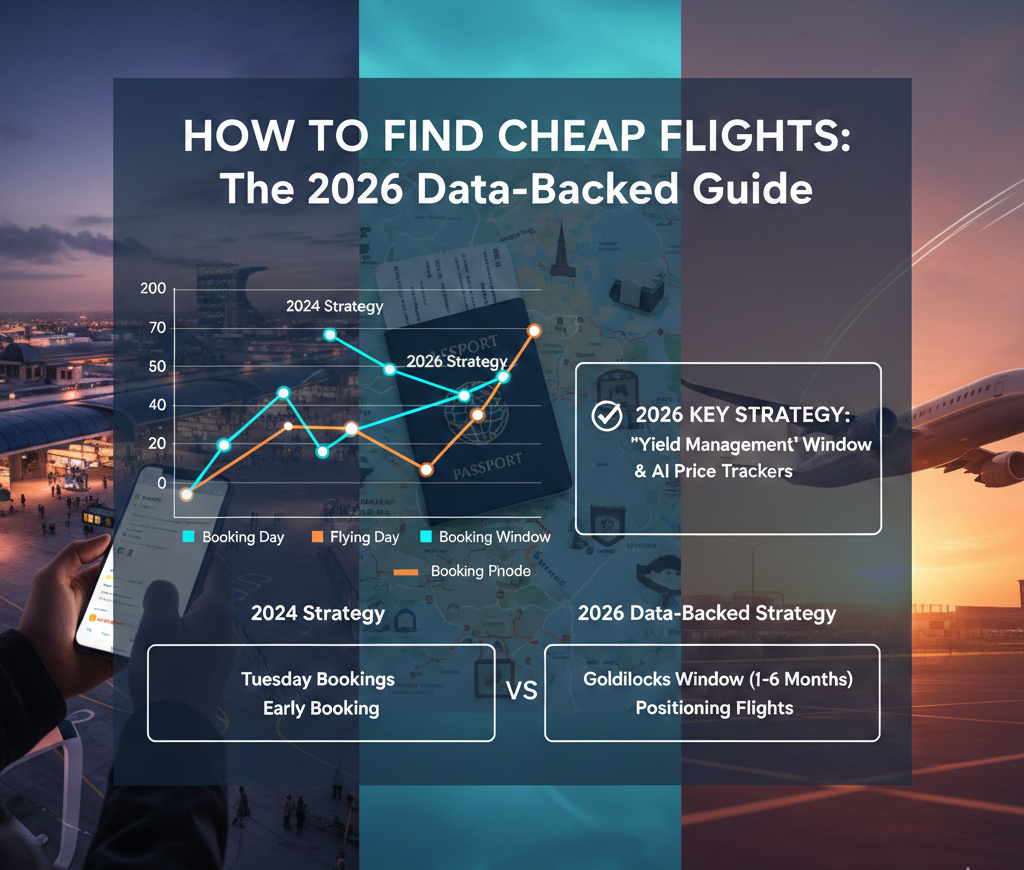
Comparison Table: 2024 vs. 2026 Booking Trends
| Feature | 2024 Strategy | 2026 Data-Backed Strategy |
| Best Booking Day | Tuesday | Any day (Use Price Alerts) |
| Best Flying Day | Tuesday/Wednesday | Wednesday/Saturday |
| Booking Window | As early as possible | The “Goldilocks” (1-4 months) |
| Hidden Gems | Error Fares | Positioning Flights & Rail-Air combos |